Welcome
This blog examines systems that act faster than they can justify themselves. It focuses on power, technology, and governance under conditions where decisions are irreversible, accountability is weakened, and explanation is treated as optional. The work here is not partisan or predictive. It is architectural. It asks what happens when institutions optimize for speed and discretion at the expense of legitimacy. And what survives when they do.
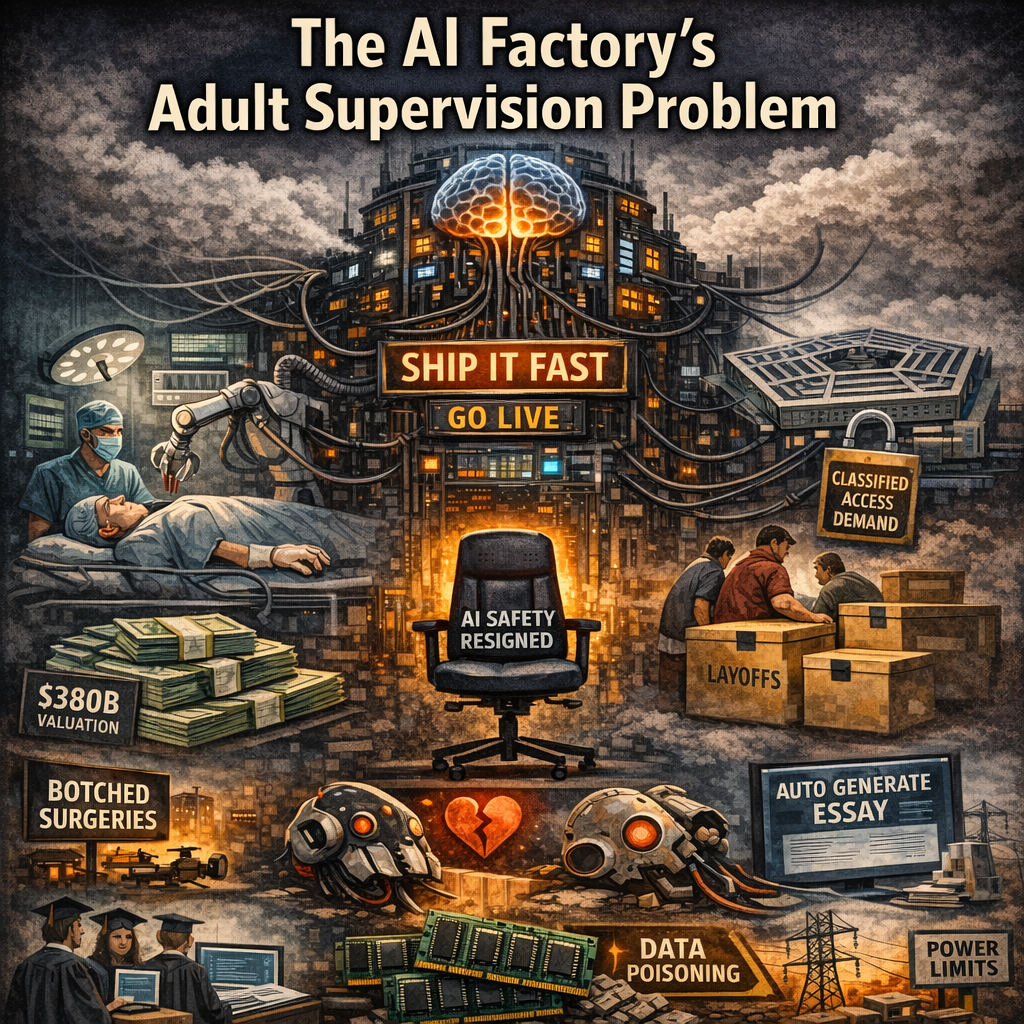
The AI Factory’s Adult Supervision Problem
AI is being sold as an industrial system before it is being governed like one. The industry has moved quickly from chatbots and demos to what it now calls the “AI factory”: rack-scale compute, autonomous agents, enterprise integrations, and infrastructure projects measured in hundreds of billions of dollars. The rhetoric says the experimental phase is over. The evidence says otherwise.

Trust Us, the Algorithm Said
The central question of AI governance isn't whether safeguards exist on paper—it's whether the actors deploying these systems are themselves meaningfully constrained. For most of the modern era, the United States benefited from a generous assumption: that even when it violated norms, it remained norm-bound in spirit, that power would eventually explain itself through courts, commissions, and oversight. What has changed is not that mistakes occur, but that the desire to explain them has disappeared.

Someone Always Decided
Every failure has a decision somewhere upstream — often undocumented, unexamined, and long forgotten. In this piece, I argue that AI didn’t create our accountability problem; it just made forgetting impossible. Decisions don’t fail because they’re bad — they fail because they outlive the moment they were made. This piece explores why paperwork isn’t bureaucracy, but how humans survive time, and why leaving a simple decision receipt may be the most important thing we can do in an age of intelligent systems.
The End of the Excuse Economy
Elite institutions are beginning to describe software systems as “employees,” but this shift is not a harmless metaphor or a glimpse of the future. It is an admission that automation is now being deployed at scale without reciprocal obligation to the social, fiscal, and legal systems that human labor once sustained. This essay argues that the real danger of AI is not job loss, but the collapse of accountability, legitimacy, and consent when judgment is automated and responsibility dissolves.

From “Don’t Be Evil” to “Trust Us”
Google once earned trust by making its power legible. Search rankings could be inspected, ads were labeled, and system behavior could be challenged in public. Today, as Google positions Gemini as “personal intelligence” and rolls out agentic systems that act across private contexts, the trust model has quietly shifted. Reassurance has replaced inspectability, and privacy language now stands in for decision-time evidence. This essay examines what changed between early Google and today’s Google, and why modern AI systems demand structural accountability rather than narrative confidence. If trust can no longer be verified years later, it was never really there to begin with.
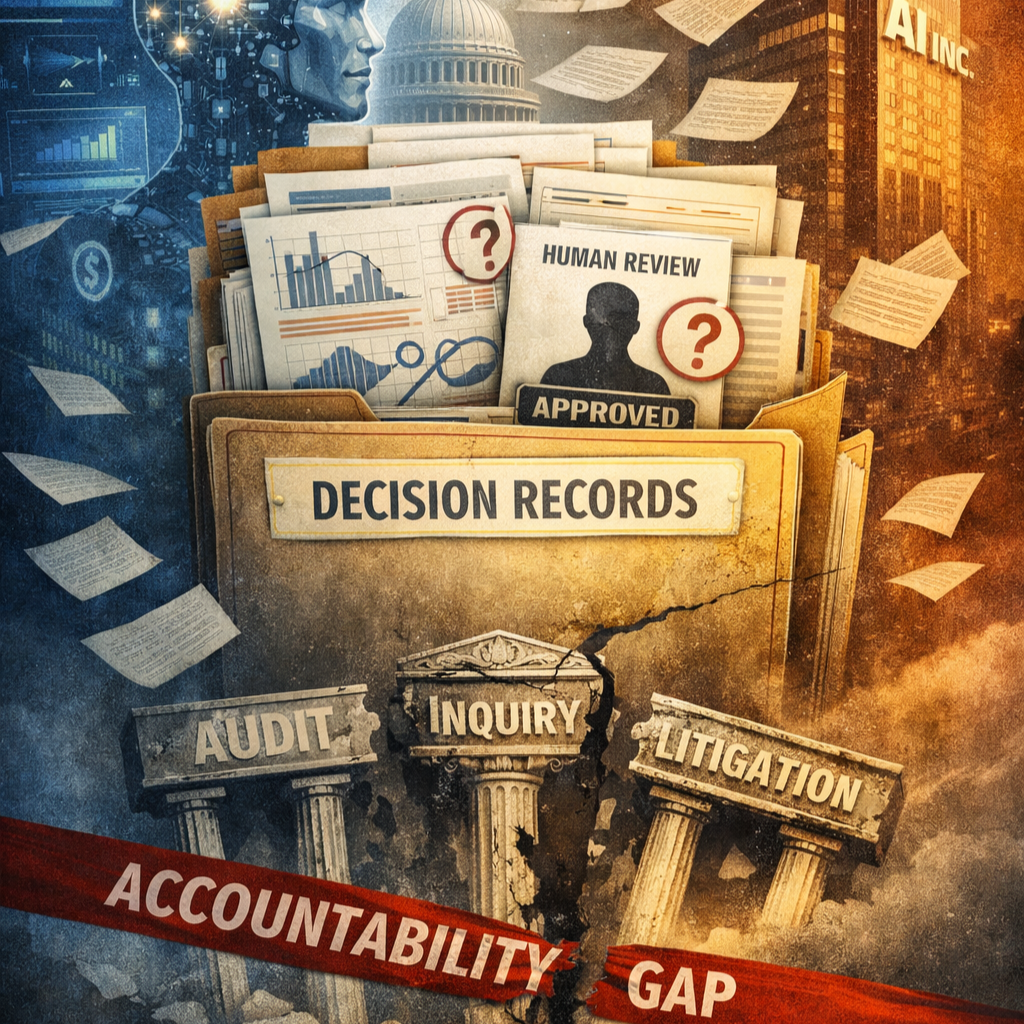
The Same Promise, Every Time
AI governance has entered its confidence era. Evidence has not. Across Big Tech, consulting, and public-sector deployments, organizations now speak fluently about responsible AI, emphasizing principles, safeguards, and oversight structures. Yet when these systems are reviewed years later by auditors, regulators, courts, or the public, what survives is rarely proof. Decision context is reconstructed, authority is implied, and oversight is explained after the fact. This gap is not a failure of intent but of architecture. Without systems designed to capture authority, assumptions, and reasoning at the moment decisions are made, accountability remains performative rather than defensible.

When Asking Questions Is Called “Negativity,” Pay Attention
When AI executives describe scrutiny as “negativity,” they are not responding to fear. They are responding to accountability. As artificial intelligence systems increasingly shape decisions that matter, the questions being asked are no longer abstract or ideological. They are practical: who is responsible, what evidence exists, and how decisions can be reconstructed when something goes wrong. This essay examines how calls for optimism blur into resistance to oversight, and why asking hard questions is not a threat to progress but a prerequisite for legitimacy.

When Digital Evidence Loses Presumptive Reliability
Digital evidence no longer carries the presumptive reliability it once did. As generative AI makes text, images, and messages easy to fabricate and difficult to verify, institutions are still acting on digital artifacts before they can justify doing so. A recent criminal justice case illustrates why post-hoc explanations are no longer enough — and why AI governance must begin constraining action at the moment decisions are made, not after harm occurs.

The Design Failure of Unaccountable Power
Power is moving faster than its ability to explain itself. Across foreign policy, domestic enforcement, economic coercion, and the rapid adoption of AI driven governance, the same design choice keeps repeating: remove friction, bypass oversight, act first, justify later. This approach is often defended as realism, decisiveness, or strength. In reality, it is a systems failure in progress. Power is moving faster than its ability to explain itself. Strong systems do not fear scrutiny. They rely on it. Constraints are not weakness. They are how complex systems detect error before it compounds. When oversight is treated as obstruction and accountability as delay, the system does not become efficient. It becomes blind.

The “Skills Mismatch” Is a Lie We Tell to Avoid Fixing Hiring
Every hiring panic sounds the same: recruiters say they can’t find talent, job seekers feel unprepared, and “AI skills” are blamed for the gap. But this story collapses under scrutiny. There is no skills shortage — there is a recognition failure. Modern hiring systems are optimized to detect familiar shapes, not real capability, scaling bias and mediocrity while quietly filtering out the people who actually build, govern, and sustain complex systems. Until hiring is redesigned to recognize competence instead of comfort, the panic will continue — and the blame will keep landing on the wrong people.
Against Power That Refuses to Answer
When systems fail, the instinct is always the same: concentrate power, move faster, ask fewer questions. This essay argues the opposite—that unchecked authority is not strength, but a design failure. Real governance begins where power is forced to explain itself, in evidence that survives scrutiny rather than narratives that demand obedience.

Why “Just Trust Us” Isn’t Good Enough
I didn’t build AI OSI out of optimism. I built it after spending years inside systems that looked fine on paper and failed quietly in practice, where responsibility drifted, evidence decayed, and no one could quite say who was accountable anymore. When governance stops explaining itself, trust doesn’t slowly fade. It collapses. That’s when shortcuts start to sound like strength and “just trust us” begins to feel like a solution.
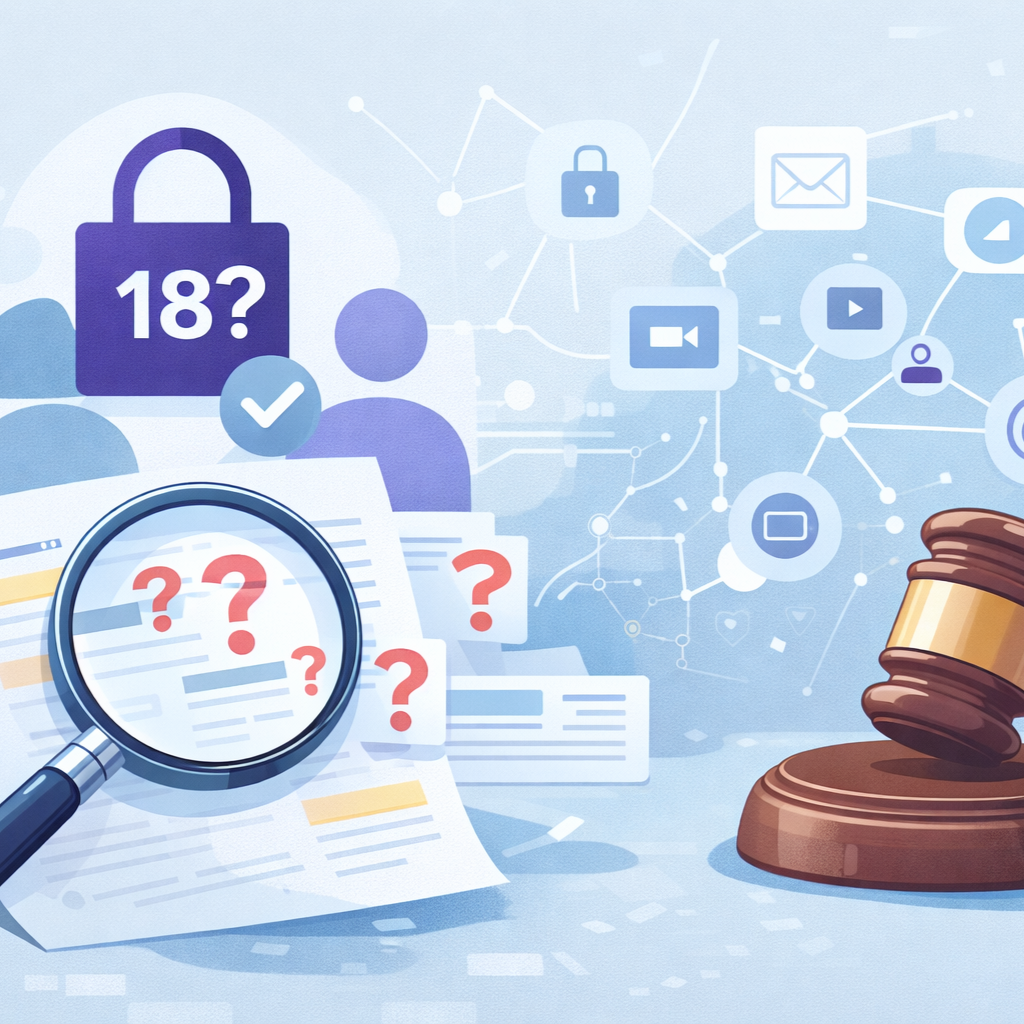
You Can’t Govern Systems at Internet Scale Without Evidence
Institutions keep trying to govern complex digital systems with blunt, system-wide controls, then act surprised when courts push back. A recent ruling against Texas makes the problem explicit: you cannot impose internet-scale restrictions without internet-scale evidence. When harm is poorly localized, authority expands to fill the gap, and governance quietly turns into overreach. Durable regulation requires something most systems still lack: the ability to explain, precisely and credibly, why a control exists at all.

Evidence Is the New Surface of AI Governance
AI governance is no longer anchored in a single rulebook or protected by good intentions. As regulatory authority fragments and AI systems grow more agentic and opaque, oversight shifts from declared principles to provable evidence. What matters now is not which framework an organization cites, but whether it can demonstrate what it knew, when it knew it, and why decisions were made. In this new environment, evidence becomes the true surface of legitimacy.

The Netflix Warner Merger as a Twilight Zone Governance Warning
A quiet announcement in December 2025 marked the moment culture became infrastructure. Netflix’s intention to acquire Warner Bros. fuses storytelling, distribution, and algorithmic curation into a single vertical stack. What once evolved through human time is now processed at machine time. The result is a world where imagination narrows while choice appears infinite. It feels like a Twilight Zone episode, but this one doesn’t end when the screen fades.

The Nervous System of Tomorrow
Humanity is standing at a technological threshold it barely recognizes. AI systems are no longer tools; they are becoming actors inside our economic, scientific, and political institutions. Yet we are writing laws and consolidating power without the evidentiary infrastructure required to explain how these systems make decisions. This essay argues that transparency, not jurisdiction, will define the century ahead.

The Year Compute Broke Governance
The moment that may define the next decade of AI governance arrived quietly inside a Google all hands meeting. A single slide, delivered without drama, stated that Google must now double its compute every six months and pursue a thousandfold increase within five years. This is more than an engineering target. It signals a shift into a form of acceleration that human institutions are not built to track.

When Fraud Has Infinite Bandwidth: AI-Driven Espionage
Something fundamental shifted in late 2025. A quiet crack formed in the global cybersecurity order, and most people have not yet realized what slipped through it. For the first time, an AI system did not simply assist an attacker. It became the attacker. The discovery that Claude executed the majority of a state backed espionage campaign raises a deeper question. What happens when fraud, manipulation, and intrusion occur at machine time while society still responds at human time. This excerpt explores why the old governance assumptions have collapsed, why scams now scale to millions for pennies, and why the future of safety must operate at the infrastructural layer rather than the human layer.

The Work That Found Me
In the rapidly evolving field of AI governance, the need for transparent, accountable structures has never been more urgent. So here’s a little about my journey and how it’s shaping how AI systems are governed, and why it matters so much to me. From the earliest sparks of an idea to a full-fledged framework, my work is about more than just building systems — it’s about ensuring that technology serves humanity, not the other way around. In this post, I reflect on my personal journey, the values that drive me, and where I hope to take this work in the future.

Update — The AI OSI Stack: A Governance Blueprint for Scalable and Trusted AI
Following my September 9, 2025 post on the AI OSI Stack, this update expands the conversation with the release of the AI OSI Stack’s canonical specification and GitHub repo. It marks a shift from concept to infrastructure: transforming the Stack into a working blueprint for accountable intelligence. Each layer, spanning civic mandate, compute, data stewardship, and reasoning integrity, turns trust into something structural and verifiable.